Free Shipping for all Order of ₹500
COD payment is available.


Cetrimide Agar: When Selective Growth Becomes a Microbial Clue
Cetrimide Agar: When Selective Growth Becomes a Microbial Clue
Different bacteria grow well under different conditions. Some require more nutrient-rich substances, while others can tolerate substances that inhibit their competitors.
This difference in microbial behaviour gives microbiologists a useful advantage. They can design culture media that provide certain conditions for the organism they want to find.
Cetrimide Agar is one of the media used for microbiological testing.
In its formulation, the nutrition elements are mixed with a selective agent to facilitate the growth of a particular microorganism.
Understanding the medium begins with its formulation. Every component plays a role, whether it’s promoting growth or providing the necessary selective conditions.
So, what exactly is this medium and why is its formulation useful?
What is Cetrimide Agar?

Cetrimide Agar is a selective culture medium primarily used for the isolation of Pseudomonas aeruginosa. It is a selective medium because of the presence of cetrimide.
The medium is particularly associated with the examination of samples where P. aeruginosa may be present. Its formulation allows creating conditions favourable for the intended testing purpose.
Microbiologists can examine the resulting colonies for characteristics that may support further identification. These characteristics can include colony morphology and pigment production.
However, visual characteristics are not always enough to make a definitive identification. Microbiologists may require additional tests to confirm the identity of the organism.
Composition of Cetrimide Agar
The composition of the cetrimide agar consists of nutritional ingredients, mineral salts, a selective agent and a solidifying agent.
Each component contributes a particular component to the medium and assists in the overall formulation.
| Ingredients | Gms / Ltr |
| Pancreatic digest of Gelatin | 20.000 |
| Agar | 13.600 |
| Dipotassium sulphate | 10.000 |
| Magnesium chloride | 1.400 |
| Cetrimide | 0.300 |
Pancreatic Digest of Gelatin provides nutrients that support microbial growth. Agar gives the medium its solid consistency.
Dipotassium sulphate and magnesium chloride provide mineral components within the formulation. These components also contribute to conditions that support pigment production by P. aeruginosa.
Cetrimide serves as the selective component of the formulation. Its presence gives the medium a property that distinguishes it from general-purpose culture media.
Together, these ingredients create the formulation required for the intended microbiological application.
Understanding the role of Cetrimide
Cetrimide belongs to the group of quaternary ammonium compounds. It is an antimicrobial agent with surface activity.
It has chemical properties that enable it to react with cell membranes of microorganisms. This interaction may disrupt normal functions of the membrane.
The structure of cetrimide is responsible for its surface-active behaviour. Its antimicrobial action makes it useful for selective culture media.
However, different microorganisms show different levels of sensitivity to cetrimide. This difference allows the medium to favour organisms such as P. aeruginosa.
For students, the key idea remains simple. Cetrimide creates a pressure intolerable to many bacteria, but P. aeruginosa is able to grow.
How is Cetrimide Agar used?
Microbiologists inoculated an appropriate specimen onto the prepared medium. They then place the plate in suitable laboratory conditions.
The culture plate is observed for growth of microorganisms after incubation. Colony morphology, pigmentation and other visible characteristics can be observed.
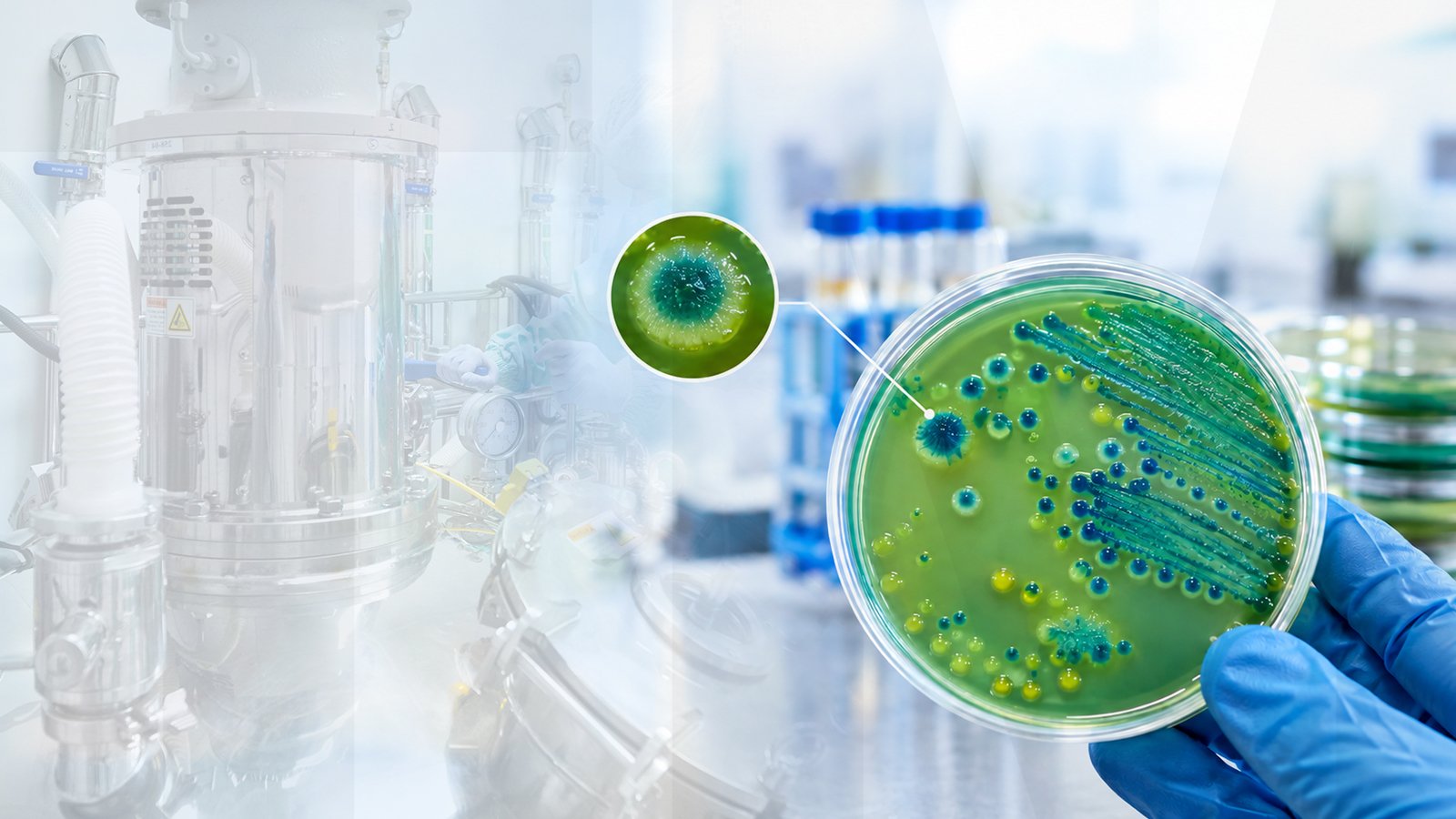
During normal growth, P. aeruginosa can produce a characteristic pigmentation. Some strains produce blue-green or yellow-green pigments.
Pigmentation may differ in strength and nature among strains. Hence, microbiologists should consider alternative identification methods when necessary.
The medium works best as part of a larger identification process. It is a useful piece of initial information, not a full identification on its own.
What does growth on the medium tell us?
Growth on cetrimide agar may suggest the possible presence of P. aeruginosa. The observation becomes more useful when microbiologists consider several characteristics together.
Colony appearance can provide an initial clue. Pigment production can provide another useful characteristic.
Some strains produce pyocyanin, which gives colonies or the surrounding medium a blue-green appearance. Other strains may produce pyoverdine.
Pyoverdine can create yellow-green fluorescence under ultraviolet light. This fluorescence can be used by microbiologists to identify some P. aeruginosa colonies.
However, not all strains have the same visible characteristics. Pigment production can also be influenced by environmental conditions.
Therefore, for precise identification, microbiologists use additional biochemical, molecular or other methods of confirmation.
Limitations and points to remember
Selective media can provide useful information but do not always allow for final identification.
Some microorganisms may show luxuriant growth under selective conditions. Some strains of P. aeruginosa may show weak or unusual pigmentation.
Microbiologists should therefore interpret results carefully. They should interpret colony characteristics together with other relevant test results.
Proper handling of the samples and appropriate testing conditions also affect the reliability of the observations.
Understanding these limitations helps students avoid treating one visual result as a complete answer.
Conclusion
A culture plate can tell a much larger story than its surface suggests. The right medium can make that story easier to understand.
For microbiology students, this medium provides a straightforward demonstration of selective culture. It illustrates how a well-designed formulation can separate a target organism from other competing microorganisms.
So next time you see a blue-green colony growing on a culture plate, remember that the colour only gives one part of the story. The medium, microbial behaviour and confirmatory testing give the clearer picture.
Frequently Asked Questions (FAQs)
Q1. Can Cetrimide Agar distinguish among species of Pseudomonas?
A. Cetrimide Agar is used primarily for isolation of P. aeruginosa. It does not provide definite differentiation of all Pseudomonas species.
Q2. Do all Pseudomonas aeruginosa strains produce pigment?
A. No. Some strains will produce a small amount or no visible pigment under some growth conditions.
Q3. Can Cetrimide Agar be used for quantitative testing?
A. Yes, Cetrimide-based methods are used by microbiologists in some enumeration procedures. The precise method will vary with the sample and the standard method.
Q4. Why are magnesium and potassium salts included in Cetrimide Agar?
A. Magnesium and potassium salts can promote the pigment production of P. aeruginosa. They also contribute to the nutritional environment of the medium.
Q5. Why is selective media important in microbiology?
A. Selective media inhibit growth of undesirable microorganisms. This strategy increases the chance for isolating and studying a particular target organism.

leave a reply
Your email address will not be published. Required fields are marked *




The information below is required for social login
Sign In
Create New Account